The one-sheet
Thesis-Based Selling: Winning Enterprise AI Deals Before There Are Reference Customers, by Fru Nde.
- Author
- Fru Nde
- Published
- 2026, first edition
- Length
- 242 pages in the reader
- Read online
- tbs.fru.dev/read, no sign-up
- For
- Sales engineers, account executives and technical consultants selling AI into large enterprises
Enterprise software deals used to follow a polite script: discovery calls, polished demos, a six-month proof of concept, and three safe reference calls to make the CIO feel comfortable. In the AI era, that script is dead weight. You cannot sell a technology that reinvents itself every ninety days using a procurement process built for the nineties.
The traditional enterprise sales cycle is collapsing under three new realities:
Hands-on executives. The leaders signing seven-figure checks build with AI on their own laptops over the weekend. When you pitch a roadmap, they are fact-checking your architecture under the conference table.
Roadmap obsolescence. A standard enterprise evaluation takes the best part of a year, while AI models leapfrog each other in months. By the time procurement scores the RFP, the requirements they graded are already obsolete.
The proof vacuum. Buyers still demand proven production references, yet almost nobody has run these architectures at scale long enough to offer a safe, risk-free blueprint.
Welcome to symmetric uncertainty. On the only question that actually closes the deal, which bets will pay off and which will become technical debt, both sides of the table are operating in the dark. Sellers who show up pretending to have all the answers lose credibility in minutes. When historical proof doesn't exist, enterprise buyers don't buy certainty; they buy a thesis. They need a rigorous, written point of view on where their industry is going that they can defend to their board.
This book throws out the feature-pitching playbook and replaces it with Thesis-Based Selling. It doesn't ask you to memorize clever objection handlers; it forces you to think like an investor, take a hard stand on how work is changing, and stress-test that view with your customer:
- Lock down the core assumptions driving the buyer's business case before a single feature matrix or demo hits the screen.
- Ditch the generic RFP response for a living thesis memo written with the buyer, turning the POC from a vendor bake-off into a joint test of a shared bet.
- Put your failure conditions on the table first, showing the technical buyer exactly what evidence would disprove your recommendation, and earning their trust in the process.
- Turn AI against your own deal strategy to expose weak assumptions before a skeptical CFO or principal architect tears them apart.
Packed with a start-to-finish deal walkthrough, five theses about AI inside companies, and a deal workbook, this framework doesn't replace MEDDIC, SPIN, or The Challenger Sale. It provides the missing strategic engine those methodologies require when the market won't sit still.
Built for enterprise account executives, sales engineers, and revenue leaders navigating the chaos of AI, and for the executives across the table who have to place the bet and own the outcome.
Bio
Fru Nde is a technologist and enterprise seller. He has spent his career selling data and AI to some of the world's largest and most strategic customers, in the rooms where big software decisions get made.
He has walked large companies through two shifts: from the data centre to the cloud, and now to AI. His ground is the complex enterprise deal, where a decision passes through many hands before anyone signs, and where how a company decides matters as much as what it buys. He has watched buying patterns shift and deal cycles stretch and shrink, and he has seen what wins in the trenches and what quietly falls apart.
Thesis-Based Selling is his playbook for selling when there is nobody to point at, in a time of radical change.
He writes at fru.dev.
From the book’s About the Author. Page 241 in the reader
Photo and cover

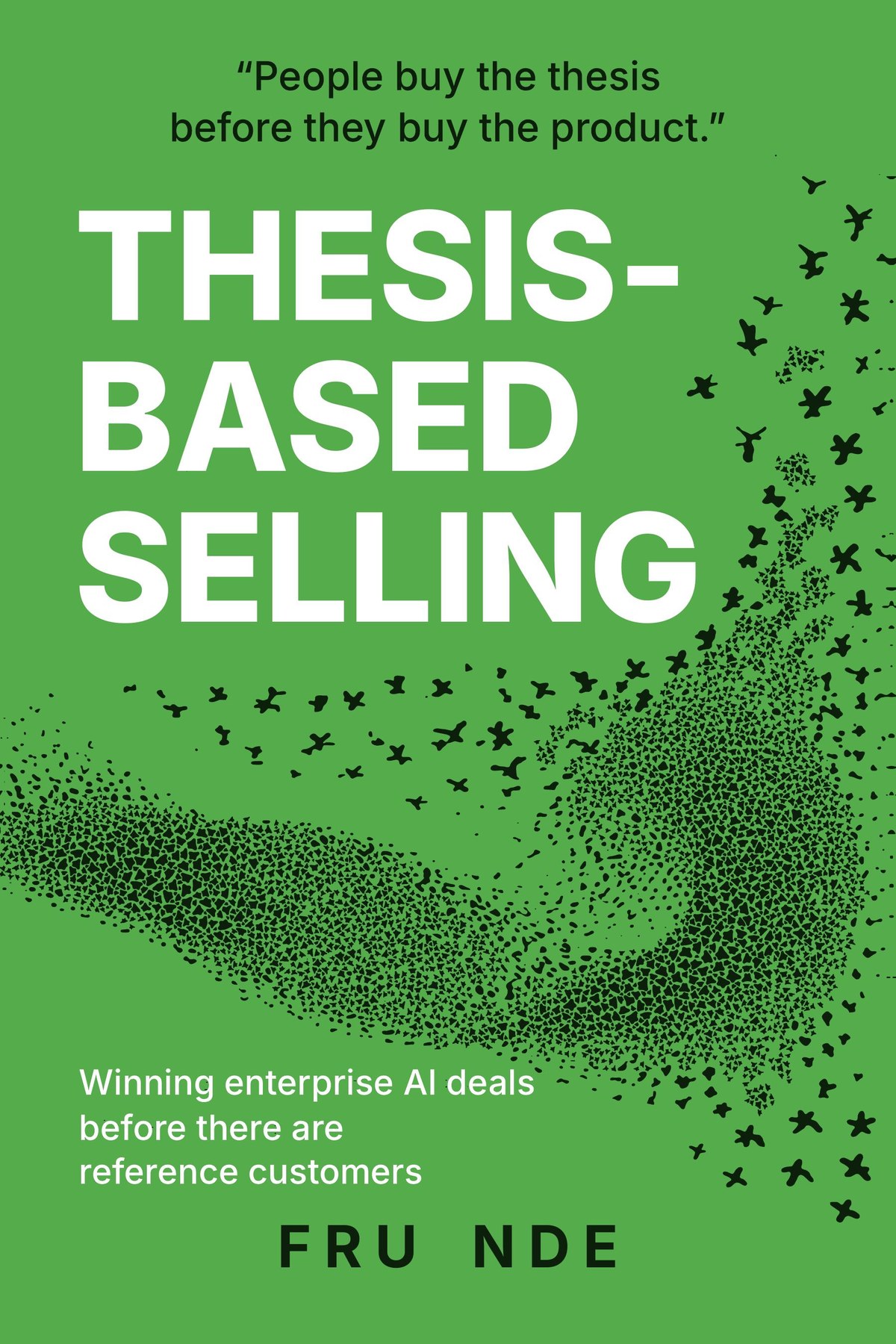
The cover is a murmuration of starlings, drawn in code for the book. Where the book is quoted, please credit it as: Fru Nde, Thesis-Based Selling, first edition, 2026, tbs.fru.dev.
Ten interview questions
Each with the short answer the book gives, and the page where it gives it.
What is the Thesis-Based Selling framework?
- A sales framework for large enterprise AI deals, where the proof a buyer used to rely on is missing.
- It finds the few beliefs a customer's decision rests on, gets the room to agree on them, and builds and defends the deal on top.
- Two rounds of three steps: establish the thesis (list, ask why, write it down), then sell on it (agree, build, defend).
Why is AI breaking the old enterprise sales playbook?
- Three shifts: the consumerized C-suite, the procurement time trap and the missing reference.
- Executives use AI models at home and test a seller's claims on their phones before the meeting.
- A buying cycle of nine months or more is slower than the AI models it is buying.
What should a seller say when the buyer asks who else is doing this?
- Say what is true, including what you do not have.
- Then: here is what we believe is true about where this is going, here is what would prove us wrong, here is what follows for you if we are right. Tell me where you disagree.
What is a thesis, and how is it different from a pitch or a vision?
- The foundational belief a decision rests on: set down, agreed on and built on.
- It passes three tests: someone could disagree with it, it stays true whoever wins the deal, and it names what would prove it wrong.
- A pitch names your product. A vision cannot be proved wrong by any date you can name.
Isn't this the Challenger Sale under a new name?
- The book says plainly that no single idea in it is new.
- What is new is holding four things at once: a claim written with the buyer and signed by them, that says what would prove it wrong, that holds whoever wins, and that lives in the buyer's own decision file.
- It sits underneath MEDDIC, SPIN and Challenger rather than replacing them.
Why do so many AI deals end in no decision?
- The JOLT research by Dixon and McKenna found 40 to 60 percent of qualified deals end in no decision.
- In AI the usual cause is that nobody agreed beforehand what evidence would be enough.
- The same pilot result means different things to people who hold different beliefs about the future.
What should replace the RFP when a company buys AI?
- A short thesis memo, written by the buying committee in its own words: the bet, why they believe it, when it succeeds, when it fails, what they keep if it fails, and when they look again.
- The RFP does not vanish. It shrinks to what really can be specified in advance, like security, data location, audit and contract terms.
How should a seller handle pushback on a thesis?
- Sort it first: a challenge on the facts, on scope, or on timing. Each has its own answer.
- Say what would prove you wrong before the buyer asks.
- Keep a ledger of every challenge and what happened to the thesis.
How should sellers use AI models themselves?
- To attack a thesis, never to originate one: an AI model tends toward the consensus, and a competitor asking the same question gets the same answer.
- Write the thesis on paper first, then ask the AI model to attack it.
What would prove the framework wrong?
- The book holds itself to the standard it sets: it states its own falsifier.
- It is wrong if teams that run thesis sessions and keep a ledger see no change in no-decision rates or cycle length against their own baseline.
- There is no controlled study yet, and the book says so and invites readers to report their results.
Contact
For interviews and press, write to fru.dev3@gmail.com, or find Fru Nde at fru.dev.